Invisalign vs. Braces for Working Adults: An Honest Comparison
September 7, 2026 · Smile Studio Boston
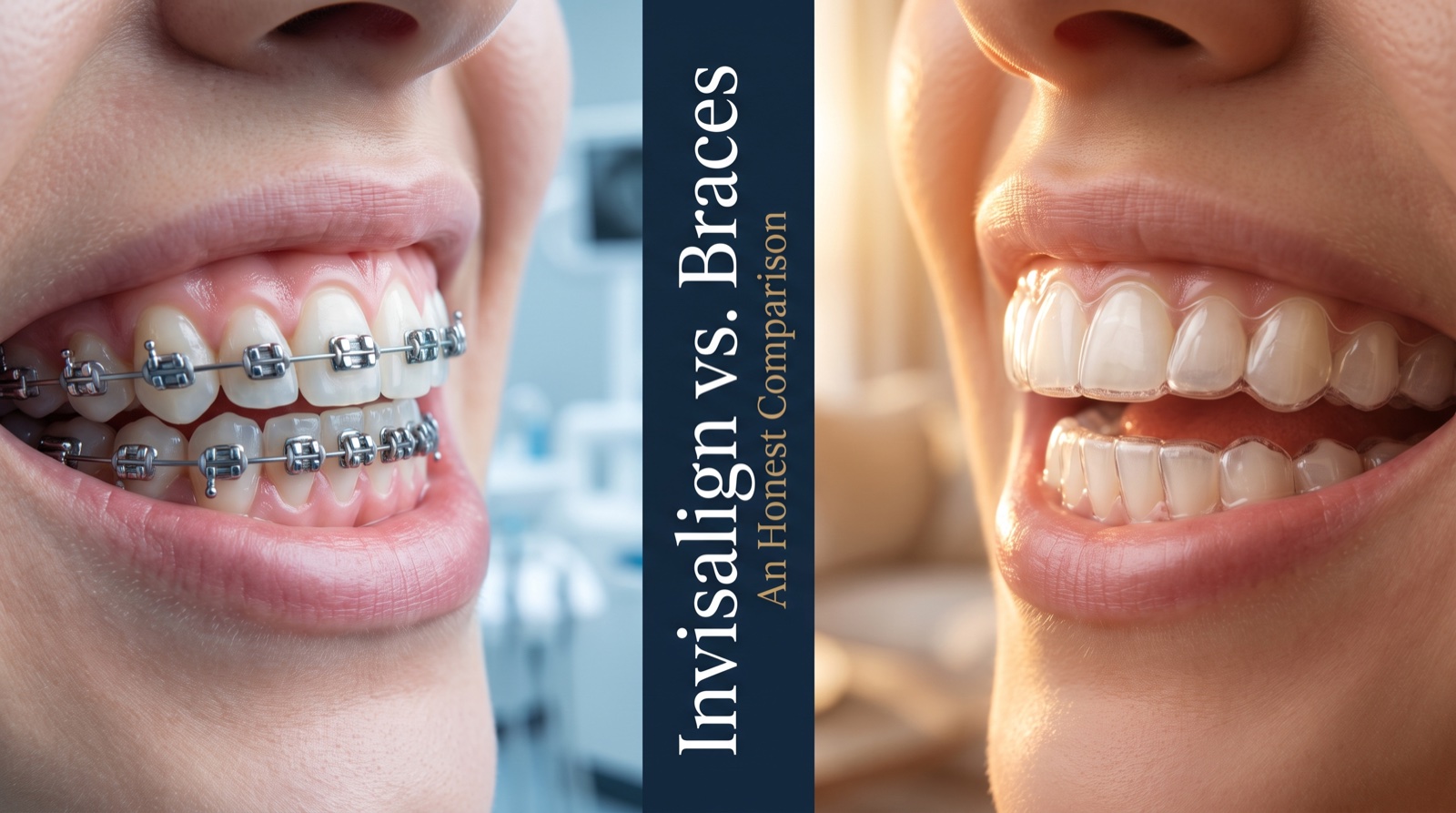
For most working adults with mild to moderate alignment issues, Invisalign wins on looks, comfort, and lifestyle, while traditional braces still win for complex bite corrections and for anyone who knows they will not wear removable trays 22 hours a day. Both straighten teeth effectively. Here is the honest comparison we walk patients through at the consult, without the sales pitch.
The head-to-head
Where Invisalign genuinely wins
Nobody notices. For adults in client-facing work, this is usually the deciding factor. Clear aligners are close to invisible in conversation, on video calls, and in photos.
Life stays normal. The trays come out for meals, so nothing is off the menu, and brushing and flossing work exactly as before. With braces, the American Association of Orthodontists recommends avoiding hard and sticky foods for the whole treatment, and cleaning around brackets takes real effort.
Fewer, faster visits. Aligner checkups are short and spaced out. Our patients routinely handle them on a lunch break, since the office is three minutes from South Station.
Where braces genuinely win
Complex corrections. Severe rotations, large bite discrepancies, and some vertical movements are still handled more predictably with fixed appliances. If your case is one of these, we will tell you at the exam.
Zero discipline required. Braces work 24 hours a day whether you think about them or not. Aligners only work while worn, and the 22-hour target is real. If you honestly know trays would live in your pocket, braces will get you a better result.
Teens and forgetful wearers. Removable means losable. For patients who want the result without managing the process, fixed wins.
What about cost and time?
In Boston, the two overlap heavily: roughly $4,500 to $7,500 for Invisalign and $4,000 to $8,000 for braces, with comparable treatment times of 6 to 24 months depending on the case. Cost rarely decides this choice; case complexity and lifestyle do. See our full breakdown of Invisalign costs in Boston and how financing turns either into a monthly payment.
The honest recommendation
Ask yourself two questions. Is your case mild to moderate? Will you actually wear trays 22 hours a day? Two yeses point to Invisalign. A no on either points to talking through alternatives. The definitive answer takes a thirty-minute exam: Dr. Jain checks your alignment and bite, shows you what aligners can do for your specific teeth, and gives you an exact quote. If braces or another approach would serve you better, you will hear that plainly. Book your free consult, or start with our complete Invisalign guide. Patients closer to Dorchester can also visit our neighborhood office via smilestudioboston.com.
Good questions
Is Invisalign as effective as braces?
For mild to moderate crowding, spacing, and bite issues, yes. For complex corrections such as severe rotations or large bite discrepancies, traditional braces are often more predictable. An exam tells you which side your case falls on.
Is Invisalign more expensive than braces?
In Boston the ranges overlap heavily: roughly $4,500 to $7,500 for Invisalign and $4,000 to $8,000 for braces. Cost rarely decides the choice; case complexity and lifestyle do.
Which is faster, Invisalign or braces?
Treatment times are comparable, typically 6 to 24 months depending on the case. Invisalign speed depends on wearing the trays about 22 hours a day, while braces work around the clock automatically.